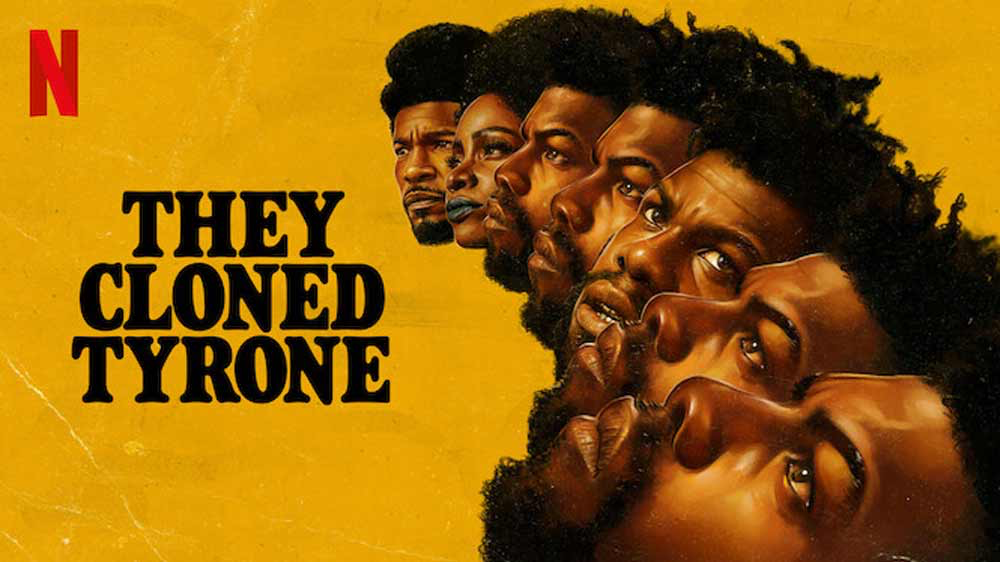
When you think of a trio destined to uncover a top-secret government experiment, surely a pimp, a prostitute, and a drug dealer were not the first to cross your mind. But to Juel Taylor, writer and director of the hit film They Cloned Tyrone, this trio’s blatant disregard for the law made them perfect for the job.
Welcome to the third installment of Malaya’s Cinema Segment, where I analyze how culture, identity, and lived experiences influence the communication between film directors and their audience. Today’s focus is the action-packed sci-fi film They Cloned Tyrone, where drug dealer Fontaine (John Boyega), pimp Slick Charles (Jamie Foxx), and sex worker Yo-Yo (Teyonah Parris), stumble across a series of unethical government operations occurring underneath their neighborhood, the Glen. The trio works strategically to infiltrate the laboratory and expose government secrets to the world.
From hair salons to strip clubs and churches, various areas of the Glen serve as the film’s settings. Each location bears a strong resemblance to many urban neighborhoods throughout the South. Director Juel Taylor credits his hometown, Tuskegee, Alabama, as being a source of inspiration behind the Glen. Taylor explains that a mixture of poor infrastructure and a lack of resources often makes “everything [feel] like it’s from the ‘80s”.

This feeling is something that Taylor manages to capture perfectly within the film. From the grainy visuals to the style and overall demeanor of characters like Slick Charles and Yo-Yo, each shot instantly transports you back to the ‘80s. However, references to topics such as Bitcoin, Blockchain, and former President Obama suggest that the film may be more modern than it seems.
Taylor utilizes this blend of retro and modern elements to effectively raise awareness about the neglect of black neighborhoods. Feeling trapped in the past is something that residents of high-poverty areas can relate to. Outdated textbooks in schools keep students behind their peers, and high rates of crime fueled by financial instability deter new and essential services from establishing themselves in the area. Consequently, residents are left without access to the latest information and resources that have the ability to drastically improve their quality of life.
The effects of this stagnation are further represented through the lifestyles of Yo-Yo and Fontaine. Despite Yo-Yo’s many accomplishments and dreams of becoming a doctor, she finds herself pushed into the world of sex work. Throughout the film, she repeatedly mentions wanting to abandon her way of life and move to Memphis, yet as Slick Charles puts it, she always “comes right back”.
On the other hand, we aren’t told much about Fontaine’s ambitions. However, the audience witnesses a crucial turning point when Fontaine realizes that every aspect of his life is manipulated and controlled by higher powers. Reluctantly, he surrenders and accepts his role as nothing more than a drug dealer. Yo-Yo’s and Fontaine’s stories showcase how the lack of resources in low-income neighborhoods prevents residents from progressing and strips them of any hope for a better future, conditioning them to become complacent with their suffering.
The stark contrast between the poorly kept Glen and the futuristic lab right beneath it further suggests that this neglect is intentional. Historically, discriminatory housing policies kept Black residents out of primarily white neighborhoods. And while the white neighborhoods continued to grow and develop, Black neighborhoods received little to no investment. This deliberate neglect made it harder for Black residents to progress educationally and financially.
Taylor takes the discussion of racial neglect a step further through the recurring theme of forced assimilation. During the film’s climax, it is revealed that the goal of the government experiments is to contort the genetics of Black people to align with European features in hopes of developing a more “united” society. In doing this, the government leaders seek to erase Black people’s history, culture, and identity. Exploring the idea of racial neglect and assimilation in the same film poses the question of how we can ethically bring Black neighborhoods into the present.
Home developers in Black neighborhoods seek to modernize these homes for a profit, often without care or consideration for residents. As a result, many residents are priced out of their own homes. The cultural history of the neighborhood and all of its memories are erased, and it becomes practically unrecognizable.
From my research, it seems dissections of They Cloned Tyrone did not thoroughly address ideas pertaining to the neglect of Black neighborhoods within the film. While it is great to discuss the film’s major themes of autonomy and assimilation, it is equally important to address the “smaller” details. Therefore, I encourage readers to learn more about the neglect and gentrification of communities and ways to invest in underfunded Black communities without harming them. After all, Juel Taylor made it clear that we can only do better if we know better, but that might be a discussion for another time.

Leave a Reply