Edited by Boyana Nikolova and Malaya Morris
Historical Foundation
Picture this: In Ancient Greece, as enslaved people worked from sunrise to sundown, and women were prohibited from taking part in sports, aristocrats spent their free time in the gymnasiums. There, they exercised, socialised, and engaged in intellectual pursuits. These daily activities were considered an indicator of one’s social status. For Greeks, sport became a way to establish social status and demonstrate the moral of beauty standards.
Wellness: In Theory, a Human Right
More than 2,000 years later, UNESCO acknowledges practising sports as a human right. Despite this acknowledgement, some are still denied the right to exercise. For example, in more oppressive countries, like Afghanistan, the Taliban prohibits women from practising sports. This means that recognising wellness as a human right does not automatically make it accessible. Across the world, different systems, political or economic, still determine who gets to work out.
Time: The Invisible Barrier to Wellness
Furthermore, practising sports is hard for people even in developed countries. For instance, the average American works 8.4 hours on weekdays, not counting the median 2.5 hours of household activities per day and time spent commuting. Add that to the mandatory 8 hours of sleep, and time becomes the greatest wealth in the world. –With people working to survive, how can they be expected to take care of their bodies?
The Price of a Healthy Body
And the obstacles don’t stop there. For those with a limited income, maintaining a healthy lifestyle can feel extremely challenging. With healthy food costing more than twice as much as unhealthy options, and gym memberships costing around $40 per month, people must invest not only their time but also their money into their physical well-being. As health becomes expensive, people who have a low income can’t have this lifestyle. Studies show that 26.5% of men earning less than $10,000 annually are obese compared to 24.6% of men earning more than $75,000. Meanwhile, 35.6% of women in the lowest income group are obese compared to 15.5% in the highest income group. This indicates that being fit is not exclusively a lifestyle but a privilege.
Health as a Status Symbol
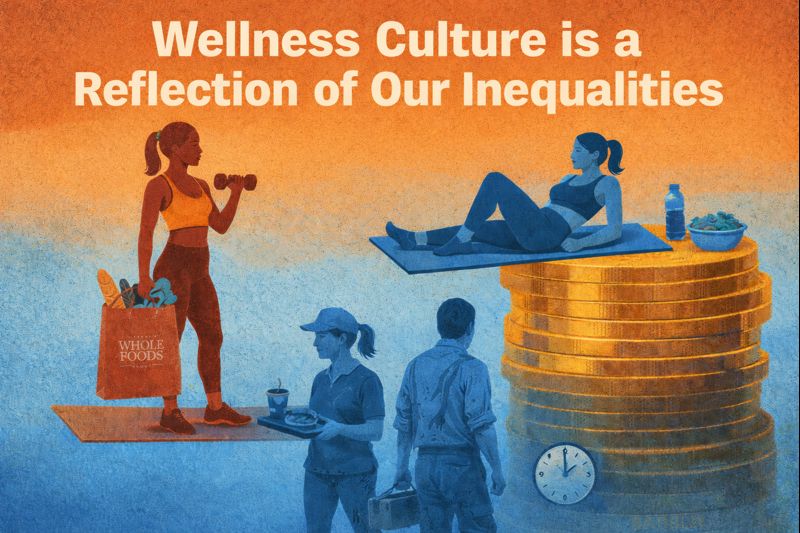
Rich people have the time and money to spend on healthy food, pilates classes, and gym memberships, much like the ancient Greek aristocrats spent their free time working out in gymnasiums. That privilege has been and still is a flex, proof that wellness is a status symbol, separating and segregating social classes. As time becomes a privilege, practising sports—a human right—is now a reflection of how inaccessible self-care is.
How Social Media Highlights this Inequality
In today’s day and age, social media further highlights the inequalities within wellness, with influencers posting their skin care routines, pilates classes, and marathon training. Influencers rarely show the resources behind their routines, such as flexible time and sponsorships. As they do that, they portray their lifestyle as not only privileged but disciplined. This sets a clear tone: if you have discipline, you can do anything. Even if it’s unintentional, influencers represent self-care as a choice, setting impossible standards for people that can lead to harmful behaviours like perfectionism, self-criticism, and eating disorders. Influencers determine the new health standard: posting gym photos and shopping at Whole Foods.
The Myth of “Free” Health Care
Some may argue that some healthy things can be for free, like fitness classes on YouTube and home-made food. But consider a person who is in survival mode, with barely any energy to simply fry an egg after a double shift. Not only are their bodies exhausted, but their minds are too, and mental exhaustion can make “free” choices, like going for a run, feel like a battle. To live in the capitalist world, hard-working people run in a state of burnout, forcing them to neglect their well-being.
A Collective Responsibility
As the capitalist system, with its extensive work journeys, denies wellness for the majority of the population, one thing becomes clear: it’s not a moral failure to struggle when your environment works against you.
If we want wellness to be a human right, then it shouldn’t depend on privilege. Rather, health needs to be a collective responsibility. To move in that direction, we need shorter working hours, affordable healthy food, and government incentives. We have to make taking care of ourselves something everyone can do, make taking care of ourselves something that isn’t just for the wealthy.

Leave a Reply